OEM vs Third-Party Parts and Manuals for Pumps and Power Tools: An Honest Comparison
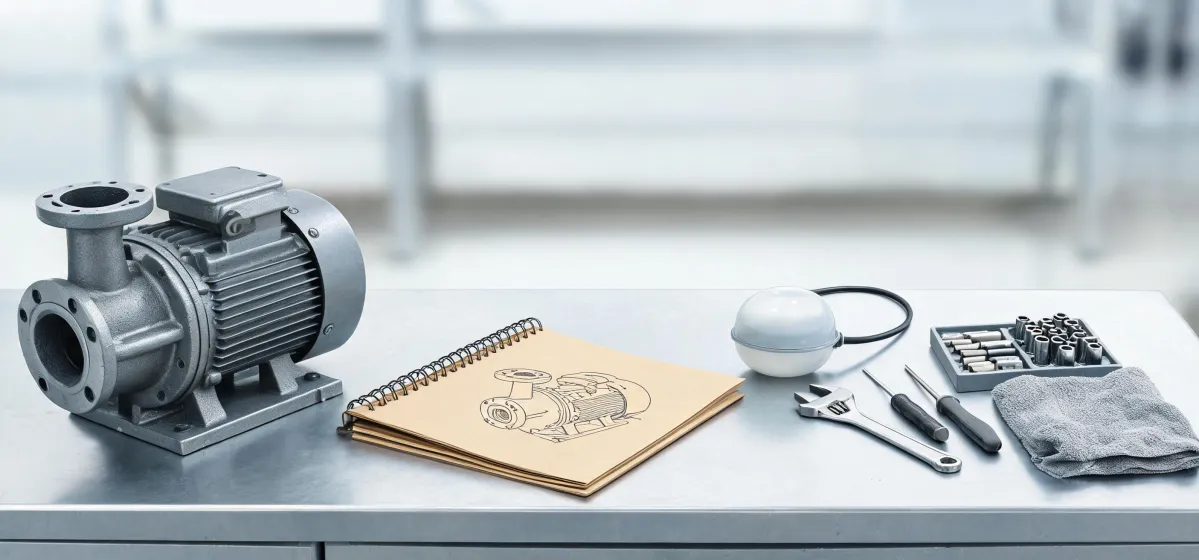
What I'm comparing (and why both channels have cost me money)
I've been buying replacement parts and documentation for a water and sewer service company for nine years. I've personally made — and documented — six significant sourcing mistakes, totaling roughly $4,300 in wasted budget. Now I maintain our team's OEM-vs-aftermarket checklist so nobody else has to learn it the way I did.
Here's what this piece compares: manufacturer-direct sources (OEM) versus third-party and aftermarket sources, for two things that always travel together — replacement parts and equipment documentation.
Why those two together? Because they fail together. Wrong manual, wrong part. Wrong part, and now you're digging through a manual at 9 p.m. trying to work out whether it's the part or you.
I'm scoring both channels on four dimensions:
- Documentation accuracy
- Part fitment
- Cost and lead time
- What happens when it goes wrong
Up front: neither channel wins outright. The answer flips depending on whether the equipment is still in production, and it flips again depending on whether a mistake costs you $40 or a callback.
Dimension 1 — Documentation accuracy
This is where I've lost the most time, and it's the least glamorous dimension, so nobody compares it.
On the OEM side, documentation is keyed to a model and often to a revision or serial range. When a Liberty Pumps pump comes back on a callback, or when we're commissioning a Liberty Pumps Ascent II grinder pump on a low-pressure sewer job, I pull the manual for that exact model — not the model it superseded. The revision letter on the cover is the part that matters. OEM documentation is boring, and boring is the whole point.
On the third-party side, you get whatever someone scanned. Sometimes that's fine. Sometimes it's a 2011 revision with a 2016 parts list stapled to the back. I once pulled a 185 air compressor manual PDF off a file-sharing site to set valve clearance on a portable unit. Twenty minutes in, I noticed the fastener torque table didn't match the head we actually had — same model number, different generation. The PDF was free. The two hours I spent second-guessing it were not.
Where it flips: discontinued equipment. If a unit's been out of production for a decade, the manufacturer may have archived the file or dropped it entirely, and a third-party scan or an old forum thread is genuinely the only copy left. That's the one place I'd rank third-party above OEM on documentation. With one caveat: match the revision number to your unit, or you're just guessing with nicer formatting.
Dimension 2 — Part fitment
We run saws on root-cutting jobs, and we burn through bars, chains and sprockets. Aftermarket chainsaw parts are cheap enough that the math looks obvious — often 30–40% under OEM list, as of early 2025. It's the math you don't see that gets you.
In 2021 I ordered four aftermarket chain loops from a marketplace listing that claimed to fit three different models. Two of them fit. The other two had the right bar length and the right gauge but the wrong pitch for the drive sprocket on one saw. We found out when the chain skipped under load and chewed up the bar nose. Saved maybe $60 on the loops. Spent around $310 on two bars, a sprocket, return shipping, and half a day of a tech's time — and we were a saw down on a job where the saw was the entire point. (Note to self: that is the third time a "fits" claim has cost us more than the OEM premium would have.)
Pumps are the same problem with more voltage. A check valve that threads in but doesn't seat. A float switch with the wrong cord length for the basin depth. An impeller trimmed for a different curve. Everything "fits" until it doesn't. On simplex and duplex systems it gets worse, because the control panel, the alarm and the pump have to agree with each other — and a mismatched float or panel shows up at 2 a.m. as a wet floor, not as a return.
Where it flips: categories where OEM parts are rebranded commodity hardware. Some check valves, clamps, hoses, fasteners. The part number is a label on something three other suppliers sell, and if you can read the actual maker's mark on the component — the company that manufactured it, not the company that sold it to you — buying direct is often identical hardware at a lower price. That surprised me the first time. It shouldn't have.
Dimension 3 — Cost and lead time
Third-party wins on unit price more often than not. In our shop it's roughly 60–70% of line items, though that's a feel number, not a spreadsheet I'd defend in a meeting.
OEM wins on lead time when you're ordering through a distributor with local stock. That's the trade: you pay a premium and you get it Thursday. Third-party is cheaper and the shipping estimate is a suggestion.
The honest framing isn't unit price, it's total cost. Base part plus freight plus return freight if it's wrong plus the labor hours of finding out. The lowest quoted price is regularly not the lowest total cost, and the gap is widest on anything with a deadline attached.
One more thing, and I'll timestamp it: pricing on both sides moved a lot between 2021 and 2024. Anything you read about relative cost — including this paragraph — should be re-verified against current quotes before you budget on it.
Dimension 4 — Recourse when it goes wrong
This is the dimension nobody compares, and it's the one that usually decides it for me.
OEM: an RMA process, a technical support line, and occasionally an application engineer who can tell you in ninety seconds which float switch you actually need. Warranty linkage is cleaner too — if the equipment is still covered and the failure traces back to a part, you want to be holding an invoice from the manufacturer's own channel. I'm not a warranty lawyer and I'm not going to pretend to be one — read your manufacturer's terms, because they vary and they change.
Third-party: a 30-day return window, a chat agent who reads the listing text back to you, and a warranty question you'll be sorting out yourself. That's not a knock on third-party sellers generally. It's just a different deal, and you should price it in.
Dimension 5 — Safety-critical procedures shouldn't be a coin flip
Some jobs don't belong on a third-party site. Taking a blade off an angle grinder is one of them — it's two steps done right and one trip to urgent care done wrong.
The short version: unplug the tool, engage the spindle lock, use the two-pin wrench on the outer flange, and turn counter-clockwise on most models. Most, not all — left-hand-thread spindles and tool-free locking systems exist, and if you force a left-hand thread the wrong way you'll either strip the spindle or crack the flange. Check the manual for your specific tool before you lean on anything.
Two sources I trust here and nowhere else: ANSI B7.1, which covers the use, care and protection of abrasive wheels, and the manual that shipped with the tool. For anything spinning at 11,000 rpm next to your hand, the manufacturer's document is the comparison winner by default. There's no cost argument that survives a hospital bill.
Which one to pick, by situation
Current-production pump still under warranty: OEM. Not a close call. Buy the part from the manufacturer's channel so the paper trail is boring.
Safety-critical component on a power tool — guards, brakes, flanges, spindle hardware: OEM. This is the one category where I don't shop on price at all.
Consumables and commodity hardware — chains, clamps, hoses, standard fasteners: third-party, provided you can read the actual maker's mark and you're not relying on a listing's fitment claim.
Out-of-production equipment: third-party, then verify the revision letter against your unit before you trust a torque spec.
Anything where downtime costs more than the part: whichever channel has it in stock locally today. In practice that's usually OEM through a distributor, and the premium is really a delivery guarantee you're buying.
If your situation is a fleet of five-year-old tools and pumps with no manufacturer support left, this whole comparison looks different — third-party sourcing stops being a shortcut and becomes the only road. And if you're running a shop where a callback runs you $400 and the part runs $90, the OEM premium stops looking like a premium and starts looking like insurance.
The thing I still get wrong: I default to OEM on anything electrical that sits in water. Not because aftermarket can't make a float switch. Because I've never once won the argument with myself about saving twelve dollars on a component that lives in a wet basin.

Omar Vukovic
Omar Vukovic is an independent garden and outdoor power equipment analyst covering pruning shears, loppers, hedge shears, lawn mowers, tillers, chainsaws, and related cutting systems. He applies IEC 62841-4 safety principles while comparing blade geometry, chain speed, bar length, cutting capacity, battery runtime, vibration, kickback controls, noise, ergonomics, and maintenance access. His practical articles help landscape teams and buyers choose equipment for vegetation, workload, operator control, serviceability, and seasonal operating conditions.