Should You Replace the Liberty Pump, or the Part That Actually Failed?
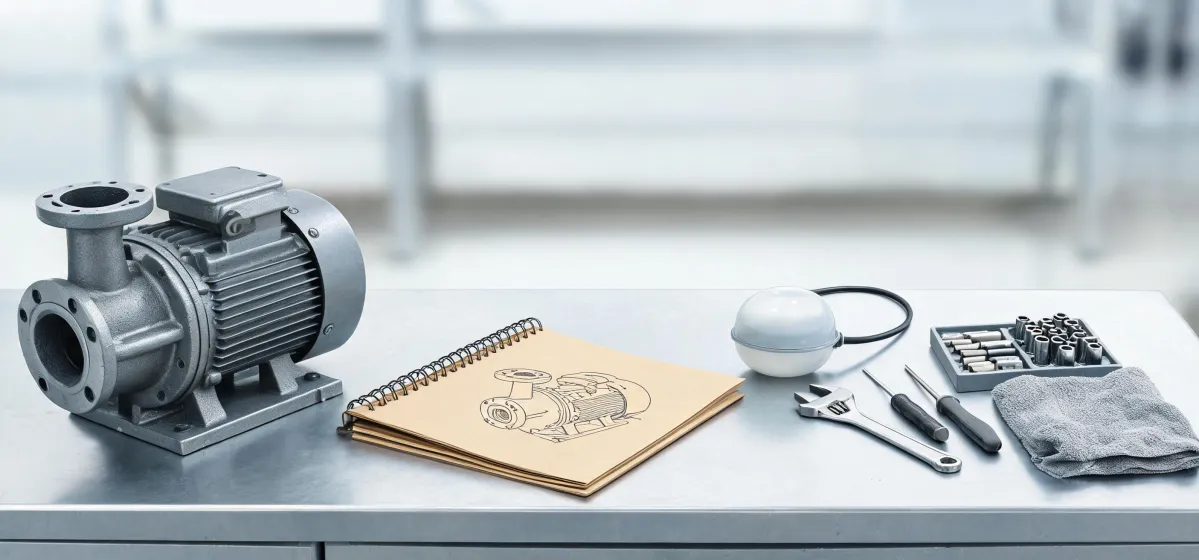
There isn't a single answer to 'why is my pump acting up?' The right move depends on the pump's motor, the basin, the duty cycle, and the part that actually failed. I manage procurement for a small pump and pipe supply company. I've tracked every invoice and service ticket in our cost system for six years, and I have about $180,000 in cumulative spending logged there. Those records changed how I buy pump parts.
I group pump repairs into three scenarios. Scenario A is a level-control problem. Scenario B is a motor or impeller problem. Scenario C is an installation problem. Each one has a different buying decision.
The question I keep hearing
Most calls start with the same question: 'Should I just order a new pump?' Sometimes yes, if the motor smells hot and the pump has reached the end of its service life. But often the pump is fine. The real failure is the float, the discharge line, or the mounting. Replacing the whole pump because one component failed is a bigger expense than the problem actually calls for.
Let me rephrase that. The goal isn't to avoid buying a pump. The goal is to avoid buying the wrong pump. I also keep a simple filter in mind when I read claims like 'maintenance free forever.' Per FTC advertising guidelines, advertising claims should be truthful and substantiated. That's a good reason to ask a supplier for installation data instead of relying on sales language.
Scenario A: The pump runs, but the float doesn't work
If the pump runs when the pit is empty, or doesn't start until water is high, the failure is often in the level control. In that case, a liberty pumps float switch is usually the repair that makes the most sense. I'm not saying this because the brand is perfect. I'm saying it because the motor amp draw is still normal and the pump still moves water.
Universal float switches are cheaper. In June 2024, I compared four suppliers for one job. The universal option was $38 less than the OEM liberty pumps float switch. My numbers said the universal switch made sense. My gut said stay with the OEM. I went with my gut, then watched a universal switch fail on another job eleven months later. That doesn't prove universal parts are always bad. It proves the risk is real, and my TCO spreadsheet needs to account for it.
Testing is cheap. Unplug the pump, inspect the switch, and if it has a float rod, clean it and watch the switch activate as you raise it. If the float switch is intermittent, replacing it with the OEM part is often faster than chasing a wire problem.
This worked for us because we're a small supplier and we can afford to see problems as they develop. If you're a one-truck service company on a callback, waiting for an OEM part may not be practical. The calculus might be different.
Scenario B: The motor or impeller is actually gone
If the pump hums, trips its thermal overload, or draws high amps and doesn't move water, the problem is likely mechanical. When that happens, a replacement pump can be the right answer. For a 1/2 HP sewage ejector, a Liberty Pumps LCU-20S is one of the models that shows up in our order history. But the model number is not a substitute for checking the installation.
We ordered several LCU-20S pumps in 2024 as direct replacements for customers who had a failed pump. Direct replacement only works if the voltage, discharge size, and basin depth match. If you search for a liberty pumps lcu-20s and the listing looks close but not exact, measure first. A one-digit difference in a model number can change the switch type or the cord length.
Before ordering a replacement pump, look at the control panel as well. A bad control panel can make a good pump look dead, and replacing the pump when the panel is the issue creates a second invoice for the same problem.
A different kind of pump question also shows up in our search referrals. People ask 'what is a case drain on a hydraulic pump' when they're dealing with a hydraulic pump, not a sewage pump. A case drain is the line that returns internal leakage oil from the pump housing to the reservoir. That's a useful thing to know if you're maintaining a skid steer. It has nothing to do with a sump basin. I use that question as a reminder to always check the pump category before ordering parts, because a bad assumption can cost more than any part number saves.
Scenario C: The pump is fine, but the installation is not
Sometimes the replacement pump fails again the same way. That is when I start asking about the installation. Is the pump moving around in the basin? Is the float hitting the wall? Is the vent blocked? Are roots crushing the discharge line?
One of our techs searched 'chainsaw near me' on the way to a callback where the pipe had been crushed by a tree root. The pump was healthy. The line was not. Cutting out the root and reworking the pipe fixed the problem. A new pump wouldn't have fixed it.
Another common cause is pump movement inside a narrow basin. If the pump drifts, the float can sit at the wrong angle. A ribbed plastic anchor kit 373517, or the equivalent recommended in the installation manual, can keep the pump in place. It's a cheap fix. It only helps when pump movement is the real issue. If the float is bad, the anchor won't help. If the float is fine but the pump has shifted, replacing the float won't help either.
Check valves matter too. If a check valve is installed backward or stuck open, the discharge column drains back into the basin every cycle, so the pump runs more often than it should. The pump isn't failing. The valve is.
The question everyone asks is 'how much is this going to cost?' The question I wish they asked is 'what evidence do I have that the pump itself failed?' Because the wrong repair almost always costs more than the part you were trying to save.
How to tell which situation you're in
What I mean by a failed subsystem is simple: the float, the motor, the impeller, the control panel, the vent, the discharge line, and the mounting are separate parts of one system. When one part fails, it can make the whole pump look bad.
Here is the list I give every service customer who wants to understand the decision before they spend money.
- Watch the pump's behavior. If it runs when the pit is empty, focus on the float and the level control first.
- Check the amperage. A motor drawing normal amps and still failing to move water is different from a motor tripping thermal overload.
- Pull the pump and inspect it. Look at the impeller, the housing, and the float. A clogged impeller is not a motor failure.
- If the pump appears healthy, look upstream. Check the basin, the vent, the discharge line, and any mounting accessories.
If you still can't tell, the cheapest diagnostic is usually a service technician who can test the pump on site. You don't need to know everything before calling. But you should avoid ordering a complete pump before someone has looked at the actual failure. The decision tree is simple: fix the failed subsystem first, and replace the pump only when the pump itself is the failed subsystem.
Why I take small orders seriously
I'll end with a purchasing philosophy that has saved me more than any spreadsheet. When I was starting out, the vendors who treated my small orders like real business are the ones I still call today for larger quotes. One liberty pumps float switch doesn't make a quarter. It does tell me that a customer is doing the right repair. On the buying side, I treat every order the same way: quote it, document it, follow up. That's why small customers end up staying with us.
Small doesn't mean unimportant, it means potential. And a supplier who respects that is a supplier I want in my cost tracking system.
If you're trying to choose between a float switch, a replacement pump, or an installation fix, start with the behavior you actually observed. That will point you to the scenario that fits. The answer is not always a new pump. But when it is, you'll know the repair is justified.

Maren Jorgensen
Maren Jorgensen is an independent hand tool and torque applications analyst covering wrenches, pliers, screwdrivers, hammers, sockets, ratchets, hex keys, and tool sets. She applies ISO 6789-1 torque-tool conformance principles while examining jaw capacity, leverage, fastener engagement, torque range, accuracy, handle geometry, and material hardness. Her practical guides help tradespeople and procurement teams select suitable tools, plan controlled tightening, and compare durability without relying on brand reputation alone.