Can a Double Check Valve Be Installed Vertically? My Liberty Pumps LE51M Lesson Cost $1,400
The call came in at 4:45 on a Friday. Finished basement, sewage ejector pit, and a pump running in six-second bursts. The homeowner was already onto his second float switch of the month, and he had the receipts to prove it.
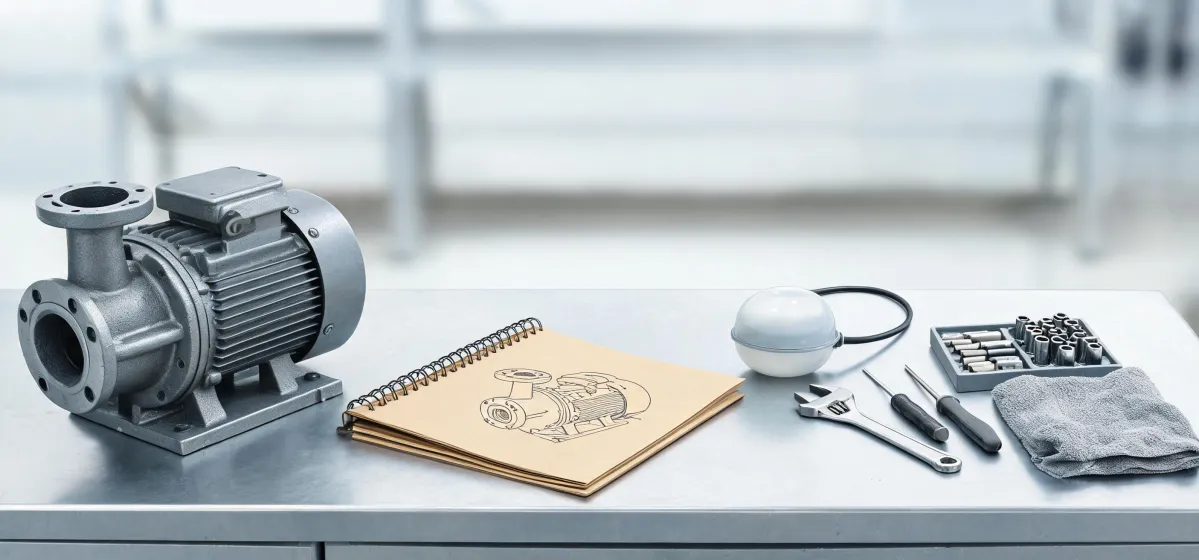
My first instinct was to blame the pump. Specifically, the Liberty Pumps LE51M sitting in that basin. It's a 1/2 hp, cast iron, 2-inch discharge workhorse—the kind of pump you install when you want to stop thinking about the pump. But every workhorse has a breaking point, and short-cycling is the classic symptom.
Here's what I did first: I checked the float, I checked the wiring, and I started writing up a quote for a new pump. Then the homeowner asked a question that saved both of us a lot of money:
"Before we do that, can we look at the discharge line?"
It wasn't the pump at all. The pump was fine. The problem was in the two feet of discharge pipe above it—and it was a problem that would have wrecked a brand-new replacement pump in a few weeks, which is exactly what I was about to sell him.
The Surface Problem: A Short-Cycling Pump
Short-cycling is exactly what it sounds like: the pump turns on, moves a little water, turns off, then repeats. It's the most common complaint in my line of work, and the standard diagnostic order goes something like this:
- Float switch stuck or mis-positioned?
- Check valve missing or leaking?
- Discharge line clogged or undersized?
That's the order I used for my first two years in the field. It's backward. Check valve problems cause more short-cycling than float switches ever will, especially in retrofit jobs where someone—sometimes me—treated the check valve as an afterthought.
In this case, a handyman had worked on the pit a few months earlier. He installed a double check valve on the discharge line because the plumbing code calls for a check valve there, and a double check is what the supply house handed him. He put it in the only place it fit: vertical, right above the pump.
That orientation mattered more than the brand of pump, the horsepower, or the float type. It mattered more than anything else in the whole system.
When I finally pulled that valve apart, the flapper hinge was worn at an angle you could see with the naked eye. The homeowner looked at it and said, "So it wasn't the float." No. It was never close to the float.
The Deep Cause: Orientation Is Not Optional
Here's the thing about check valves: they aren't all built the same, and the differences decide how they can be mounted.
A swing check valve has a hinged flapper that falls shut by gravity. In a horizontal pipe, gravity is your friend. In a vertical pipe with upward flow, the flapper hangs suspended in the flow. When the pump stops, the water column above the valve reverses and the flapper slams onto its seat. That slam sends a pressure spike back through the system—water hammer—and it repeats with every single cycle.
Now picture a pump that starts and stops thirty times an hour. That's thirty hammer blows an hour, against the valve, the pipe walls, and the pump's internal seals and bearings. The float switch rattles, the motor sees repeated hard starts, and the heat builds. The LE51M's thermal protector eventually shuts the motor down, so it doesn't self-destruct on night one. It just cooks itself slowly, which is almost worse. By the time anyone tests the motor, the damage is done.
A spring-loaded check valve, by contrast, uses a spring to push the disc closed. It doesn't rely on gravity, which is why it can be installed vertically—or upside down, or anywhere else—without slamming itself apart.
A lot of guys ask me why the manufacturer doesn't just make the valve vertical-proof. The honest answer is: the vertical-rated ones cost more, and the horizontal-rated ones are fine in the position they're designed for. A swing check is a brilliant piece of simplicity—as long as you respect what it needs.
So, can a double check valve be installed vertically?
It depends. A true double check assembly is two check valves in series inside one body (or, in the pump world, sometimes two flappers in one body). Either way, the orientation limits have nothing to do with whether it "looks right" in the pipe. They come from how the internal checks are designed—and whether the manufacturer tested and certified the assembly for vertical mounting. Some spring-loaded double checks are rated and marked for vertical. Swing-type double checks usually aren't. If the body or the spec sheet doesn't say vertical, the answer is no.
The handyman's valve was not rated for vertical. And it was the exact valve that made that LE51M short-cycle like a woodpecker, hammer itself night and day, and finally trip its thermal protector.
I want to be fair: this mistake is easy to make. The valve body had an arrow, the arrow pointed up, and the flow really did go up. Any reasonable person would call that correctly installed. But the arrow only describes flow direction. It says nothing about mounting orientation. Those are two different specifications, and one of them is printed on the same body in fine print that almost nobody reads.
I learned this at my own expense in 2019, when I installed an identical valve the same way on a service job. The pump worked for about three weeks, until it didn't. I told the homeowner it would be an hour-long job. It took four hours, three trips to the supply house, and one lesson that still sits near the top of my "don't do this again" list. The pump wasn't the failure point; the assumption was.
The Same Assumption, Different Aisles
Once I started documenting check valve failures, I kept seeing the same mental shortcut everywhere. I've serviced a pressure washer where someone rebuilt it with 3400 psi pressure washer parts and mounted the unloader at an angle the manufacturer never allowed. I've watched a hedge shears assembly get torqued together with the blade washer on the wrong side—it "worked" until it wrecked the pivot. The pump version just charges more for the lesson.
What That Vertical Valve Actually Costs
My 2019 mistake came to $1,400 all-in: two service trips, a replacement LE51M motor assembly, a properly rated check valve, and a section of discharge pipe rearranged so the valve sat where it belonged. I said "check valve" to the supply house counter guy; he heard "replace the pump." Same words, different meaning. That's a communication failure that still shows up in our crew training.
Since 2023, I've kept a log of callbacks where the root cause was a check valve in the wrong orientation. Seventeen calls in eighteen months. Roughly $12,000 in combined labor and parts. Every one of them had the same signature: a pump that "won't stop short-cycling," and a valve that was rated for something other than what it was doing.
If I remember correctly, the worst one was a duplex sewage system for a small apartment building. Two pumps, both on vertical risers with swing checks that weren't vertical-rated. They failed in sequence, and the pit backed up into the parking garage. That fix was $3,200 and a weekend.
And there's a cost that never appears on an invoice: the customer who texts you at 10:30 pm with a photo of a wet basement floor, and the sentence "I thought you fixed this." The first time I heard that sentence, I had no one to blame but myself. I had three hours to finish before the inspection—or rather, I thought I did. The rush is what made me skip the manufacturer's orientation spec. In hindsight, I should have pushed back on the timeline. With a customer watching and an inspector coming, I rushed instead of verified. That's the mistake that actually cost the $1,400.
How I Do It Now
I'm not a checklist guy because it looks professional. I'm a checklist guy because the alternative is being the reason a customer's basement smells like a swamp. Here's the short version, the one I hand to every installer who works with me:
If the discharge line runs horizontal, use a swing check valve in the horizontal run. Gravity seats the flapper, and this is the cheapest, most reliable setup for residential sewage work.
If the valve has to go on a vertical run, use a spring-loaded check valve that's explicitly marked for vertical installation. Check the body for the orientation marking, not just the flow arrow.
If you're dealing with a true double check assembly, read its installation sheet. Not the box. The sheet. And if the sheet doesn't answer the orientation question, call the manufacturer's technical support line. It takes five minutes; the callback takes all day.
Liberty Pumps' instructions for the LE51M series are clear: the discharge line needs a check valve to prevent backflow into the basin.
The manual doesn't say "any orientation works." Neither does the International Plumbing Code, which is why the manufacturer's installation sheet is the document that actually decides how the valve gets mounted.
The pump side of this industry has evolved a lot since 2019. The controls are smarter, battery backup systems are standard, and Liberty Pumps Inc—headquartered in Bergen, New York, building pumps since 1965—keeps shipping reliable, UL 778-listed equipment. But the $45 check valve sitting next to the pipe hasn't changed much, and it can still defeat a $900 pump installation. The fundamentals haven't changed: a valve's orientation rating is not a suggestion. What counted as best practice in 2020—take whatever check valve the counter gives you—is exactly the advice that created that wave of callbacks in 2023.
There's something satisfying about a system that runs for three years without a callback. After the 2023 check-valve season, teaching this one rule at a shop meeting and watching a new installer verify his valve orientation before he torqued the union down—that's the payoff.
So, can a double check valve be installed vertically? The honest answer is: only if the manufacturer says so. At least, that's been my experience across the residential and light-commercial systems I service. My answer, after the LE51M I almost replaced for no reason, is "let me read the spec sheet first." That habit has saved me more money than any tool I own.

Maren Jorgensen
Maren Jorgensen is an independent hand tool and torque applications analyst covering wrenches, pliers, screwdrivers, hammers, sockets, ratchets, hex keys, and tool sets. She applies ISO 6789-1 torque-tool conformance principles while examining jaw capacity, leverage, fastener engagement, torque range, accuracy, handle geometry, and material hardness. Her practical guides help tradespeople and procurement teams select suitable tools, plan controlled tightening, and compare durability without relying on brand reputation alone.