Five Things I Do Before Ordering Liberty Pumps: ELV290 vs. 257, Prices, and Voltage Checks
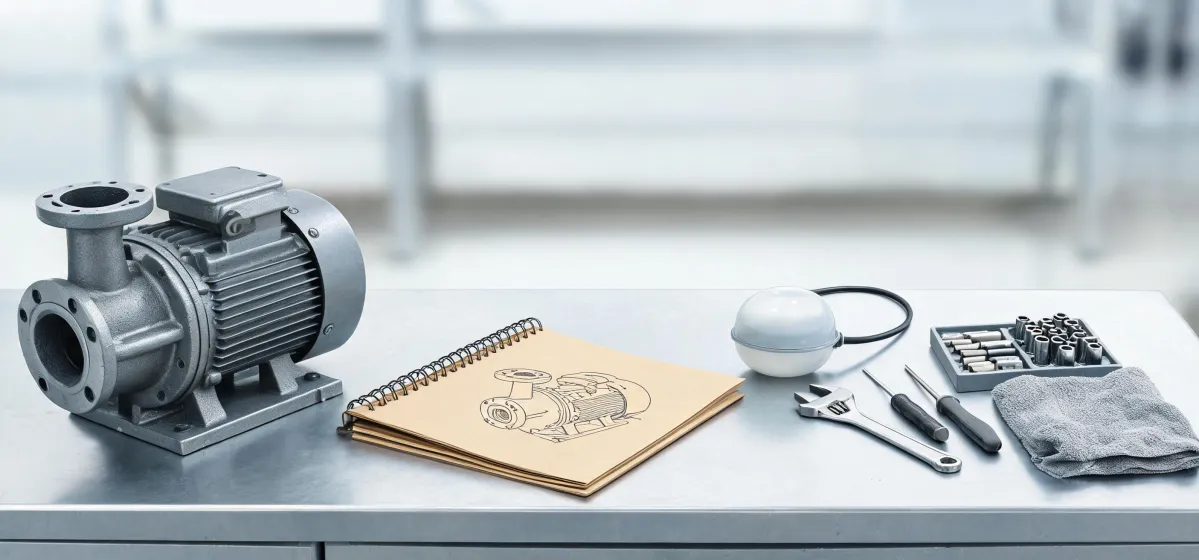
I don't design plumbing systems. I buy parts for the people who clear them when they back up. After six years of running purchasing for a 130-person fabrication shop, I can tell you that pump catalogs are not written for buyers. They are written for engineers who can visualize a head-loss curve. So I made a checklist. These are the five checks I run before I order anything from Liberty Pumps — an ELV290 sewage pump, a 257 submersible sump pump, or just a check valve and level alarm.
This won't turn you into a pump specifier. It should keep you from making the same mistakes I made early on.
1. Find out what the pit actually receives
The Liberty Pumps 257 is a submersible sump pump. The ELV290 is a sewage pump. Both have a half horsepower motor, so a lot of buyers compare them like they're interchangeable. They're not.
The 257 moves clear groundwater out of a sump pit. It has a 1-1/2 inch discharge and is built for water without solids. The ELV290 has a 2 inch discharge and is built for wastewater from bathroom groups or floor drains where solids may be present. The wrong choice usually doesn't fail on day one. It fails later, when a rag or a chunk of debris meets an impeller that was never meant to handle it.
In March 2023, I ordered the cheapest 1/3 hp submersible I could find online for a drain that had backed up in one of our service bays. Nobody told me that drain received discharge from a toilet upstream. The pump jammed after twenty minutes, the plumber's emergency visit cost more than the proper pump would have, and the maintenance supervisor still brings it up. Now the first question I ask is not which model number to use. It's what is going into that pit.
2. Measure the lift before you choose horsepower
When a supervisor asks me whether a half horsepower sump pump is enough, I ask to see where the discharge pipe goes. The vertical distance from the pump discharge to the point where the pipe connects into the gravity drainage system matters more than any flow number on the box.
Most half horsepower sump pumps have enough for a typical basement or shop installation with 10 to 15 feet of vertical lift. But if you are pumping up 20 feet or more, or pushing water through a long horizontal run, you need to look at the published performance curve, not the marketing number. Pump companies advertise flow at zero feet of head because it makes every pump look generous.
Earlier this year, we went back and forth between a 1/2 hp pump and a 1 hp pump for a pit with a 14 foot vertical discharge and roughly 50 feet of horizontal pipe. The 1 hp unit gave more margin, but it also cost more and drew more current. When I compared the two spec sheets side by side, the half horsepower unit moved enough water at the actual head we had. We ordered the 1/2 hp unit. To be fair, a 1 hp pump would have covered my mistakes if I measured wrong. So I measured twice.
3. Compare the total package price, not just the pump price
Let's talk about the phrase I see in search logs all the time: submersible pump 1 hp price. I searched that exact phrase myself when I was putting together a maintenance budget. The results were almost useless until I asked one question: does that price include the float switch, check valve, and alarm?
On a quote I received in January 2026 from our regular Liberty Pumps distributor, a 257 automatic submersible came in around $260 to $300 depending on cord length, and the ELV290 was closer to $360. A 1 hp submersible pump price in that same quote ran from roughly $430 up to $550 before you added accessories. Those are just reference points from one quote in my region, so verify current pricing at your local distributor.
The bigger trap is ordering a bare pump and assuming it is ready to run. Some pumps are sold without a float switch, some need a separate check valve, and some need a control panel or alarm contact to comply with local code. Ask for the full system price, not the pump price. The lowest quote means nothing if you have to buy the switch separately and pay an electrician to wire it.
4. Verify voltage before you sign for delivery
You can order the right model and still have installation fail because the circuit can't feed it. Voltage checks are not hard, and they belong in the buying process, not just the installation process.
If you have ever looked up how to check voltage on a welding machine because the arc seemed weak, the habit is the same here: test the supply side first. For a welder, that means checking the receptacle or disconnect that feeds it. For a pump, it means checking the circuit that will power the pump.
How I check voltage on a 115V or 230V circuit
This is the short version I use when I'm doing a preliminary check. I'm not an electrician, and I still ask one to open a live panel. But at a receptacle or an accessible disconnect, this is straightforward.
- Set the multimeter to AC voltage. If the meter has manual ranges, choose 200V for a 115V circuit and 600V or 750V for a 230V circuit.
- Put the black probe in the COM jack and the red probe in the V jack.
- For a 115V circuit, measure between hot and neutral. For a 230V circuit, measure between the two hot legs.
- Read the number. A 115V circuit should show roughly 108 to 126 volts. A 230V circuit should show roughly 207 to 253 volts.
A reading that looks fine with no load can still drop badly when the pump starts. If voltage falls more than about 10 percent while the motor runs, something is wrong: undersized wire, a loose connection, or an overloaded circuit. That is a job for an electrician, but it is worth knowing before you schedule the installation.
As for the welding machine part of that question: do not test the output side unless you know exactly what you are doing. The input side at the plug or disconnect is the safe first check. If the machine still won't weld properly, call a technician.
5. Check the basin size and float clearance from the spec sheet
So glad I started taking photos of the pit opening before ordering. Last year, we picked an ELV290 for a replacement job, and everything looked right on paper. Then the maintenance lead sent me a picture of the basin cover opening. The clearance between the discharge pipe and the cover was tight enough that the float could not travel through its full range. We changed the order before the pump arrived instead of paying a callback after installation.
Take two minutes to look at the Liberty Pumps dimensional drawing, which is available on liberty-pumps.com. Check the minimum basin width, the float travel, and the clearance above the discharge connection. A pump can be mechanically perfect and still run constantly because the float hangs up on a narrow pit wall or a poorly placed cover.
If you are not sure whether the model includes the float, ask. Many Liberty Pumps products have versions with and without a switch, and the model number usually changes by one or two letters. That one letter is exactly the detail that causes a Friday afternoon call to a distributor asking where the float switch is.
Before I send a purchase order, I read the model number out loud and compare it to the quote line item by line item. It sounds like basic stuff, but basic errors are what cause expensive callbacks. The checklist is not complicated: identify what's in the pit, measure the lift, price the complete system, check the voltage, and verify the float has room to work.
A boring purchase order is a good purchase order. The pump will still be running quietly long after everyone has forgotten who ordered it.

Maren Jorgensen
Maren Jorgensen is an independent hand tool and torque applications analyst covering wrenches, pliers, screwdrivers, hammers, sockets, ratchets, hex keys, and tool sets. She applies ISO 6789-1 torque-tool conformance principles while examining jaw capacity, leverage, fastener engagement, torque range, accuracy, handle geometry, and material hardness. Her practical guides help tradespeople and procurement teams select suitable tools, plan controlled tightening, and compare durability without relying on brand reputation alone.